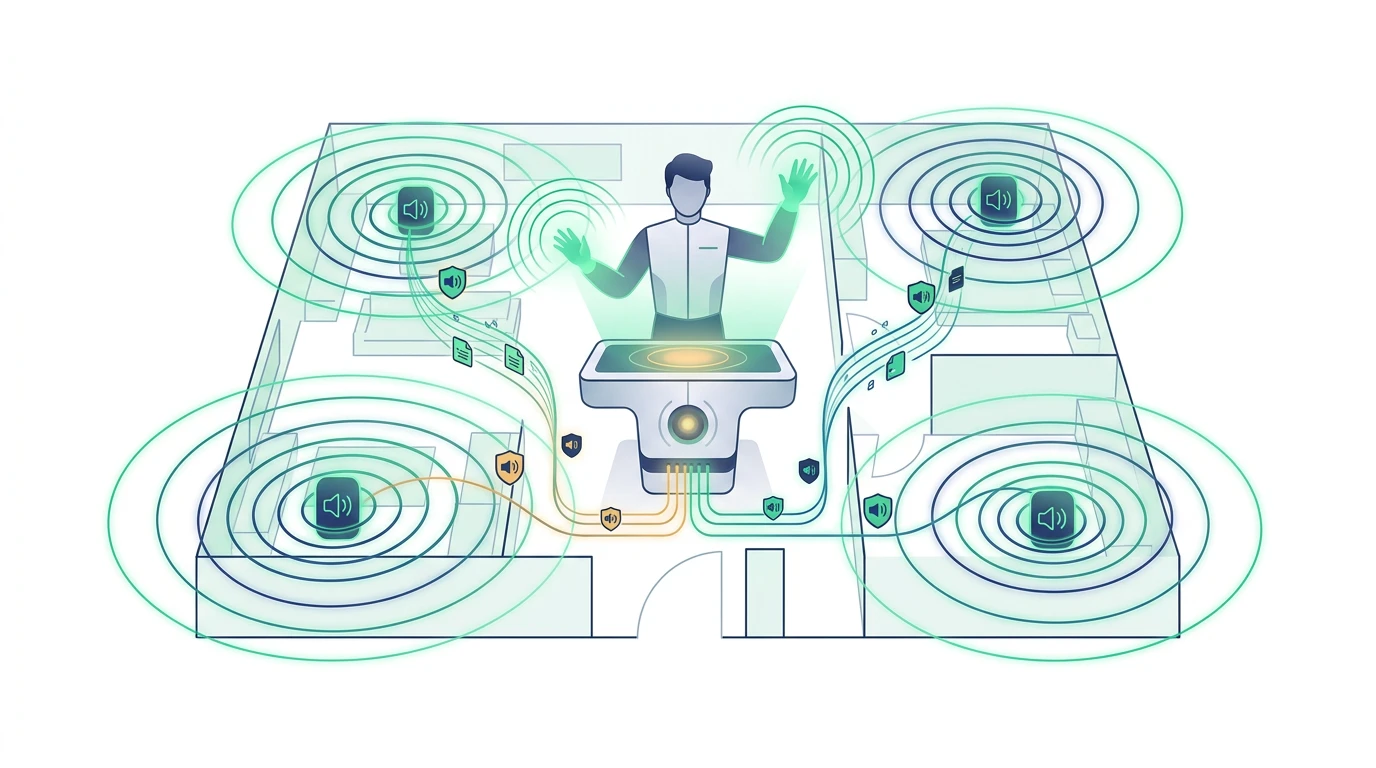
1. The Reality of Hardware Control in the Agent Era
Controlling physical hardware through an autonomous AI agent sounds deceptively simple: connect an LLM to a local network, expose playback tools, and let natural language drive the speakers.
In reality, bringing smart home audio into the Model Context Protocol (MCP) ecosystem quickly encounters physical network traps:
- The XML Token Tax: Inspecting what song is currently playing over Universal Plug and Play (UPnP) returns verbose SOAP responses wrapped in multiple layers of escaped DIDL-Lite XML, consuming 1,200 to 2,000 prompt tokens per status check.
- The Group Coordinator Drop: In stereo pairs or multi-room groups, secondary follower speakers report transport status as
PLAYINGwith empty track metadata. If an agent naively sends playback or volume commands to the follower's IP address, the speaker drops the command without acknowledgement or returns a cryptic UPnP error. - Acoustic Safety Hazards: Unlike software APIs where a bad parameter returns a JSON error, an agent executing an un-clamped volume command (
volume: 100) can wake an entire household, blow out speaker drivers, or damage human hearing. - Transient State Failures: Network jitter and rapid track switches trigger UPnP Error
701 (Transition Not Available), causing fragile agent sessions to crash mid-playback.
Sonos recently signaled a significant architectural shift with their announcement of Sonos 27. The upcoming platform emphasizes foundational improvements in speed, local reliability, modern developer interfaces, and official support for agent-readiness and MCP servers.
Built in anticipation of Sonos 27's official integration, we engineered a standalone, production-grade Go MCP server (cmd/mcp-sonos) within the homectl smart home engine.
Here is how the vertical is architected, how we solved the token economics of raw SOAP, and how the same engine powers embodied physical robotics on Jibo.
2. Layer-by-Layer System Architecture
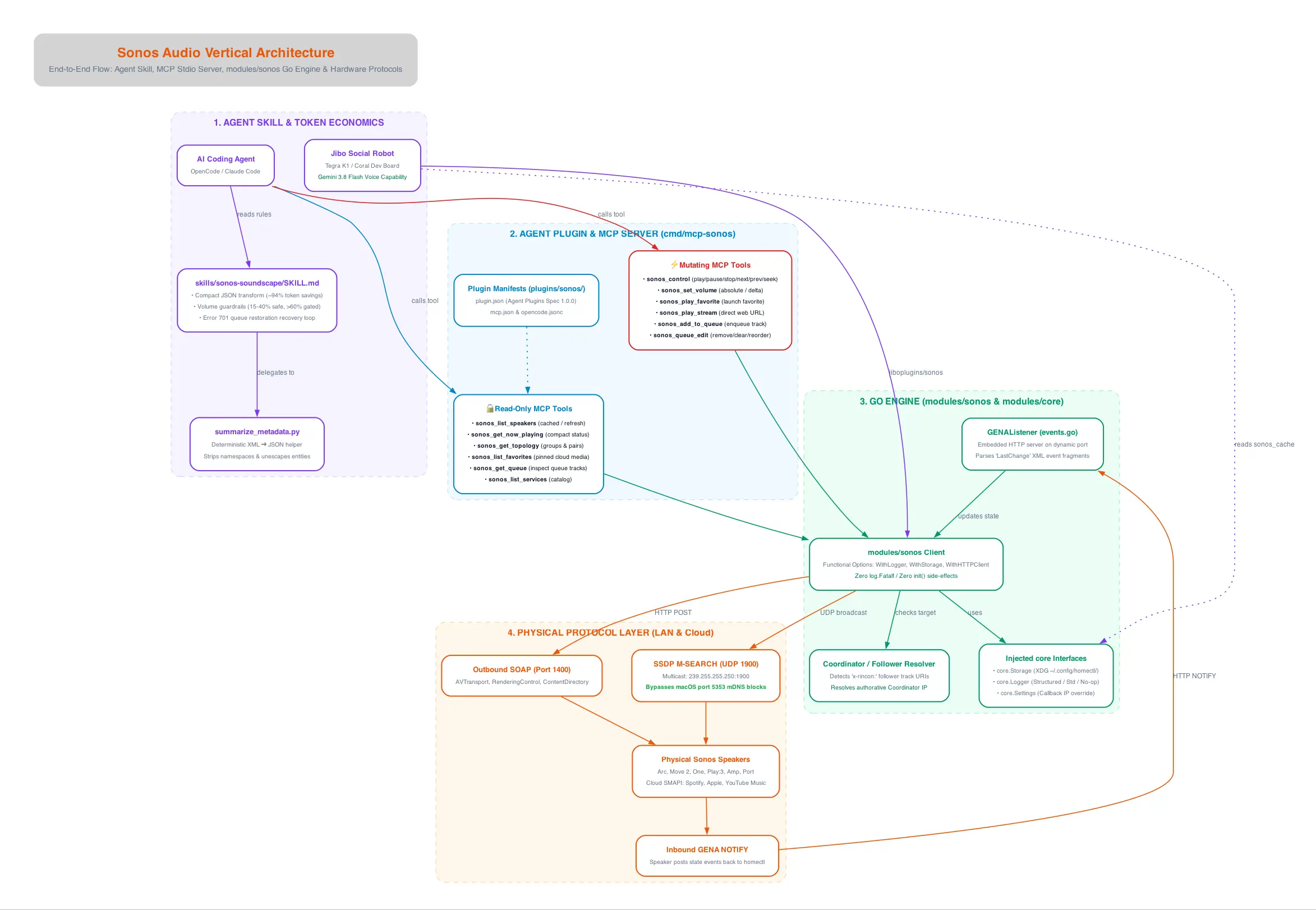
The Sonos audio integration bridges high-level natural language agent intent with low-level local network protocols:
┌─────────────────────────────────────────────────────────────┐
│                 AI Agent (Cursor / OpenCode / Claude)       │
└──────────────────────────────┬──────────────────────────────┘
                               │ JSON-RPC (stdio)
                               ▼
┌─────────────────────────────────────────────────────────────┐
│                 Standalone MCP Server (cmd/mcp-sonos)       │
│  - 12 Tools (list_speakers, get_now_playing, control, etc.) │
│  - Strict SEP-2106 Record Schema Returns (no bare arrays)   │
└──────────────────────────────┬──────────────────────────────┘
                               │ Go Interfaces & Functional Options
                               ▼
┌─────────────────────────────────────────────────────────────┐
│                 Go Domain Engine (modules/sonos)            │
│  - Group Coordinator Resolution (GetCoordinatorIP)          │
│  - Container vs Item Favorites Protocol (FV:2 / Queueing)   │
│  - Mock Testing Infrastructure (httptest.Server)            │
└──────────────────────────────┬──────────────────────────────┘
                               │ Outbound SOAP & Inbound GENA
                               ▼
┌─────────────────────────────────────────────────────────────┐
│                 Physical Network & Sonos Hardware           │
│  - Outbound SOAP over HTTP: Port 1400                       │
│  - Inbound Real-Time Push Events: GENA HTTP Listener        │
│  - Sub-500ms Local Discovery: SSDP M-SEARCH (UDP 1900)      │
└─────────────────────────────────────────────────────────────┘
The system is organized into four distinct tiers:
- Agent Skill Layer (
skills/sonos-soundscape): Token compression and safety policies. - MCP Server (
cmd/mcp-sonos): Twelve typed tools communicating over standard input/output. - Core Engine (
modules/sonos): Pure-Go domain package with zero global state. - Physical Protocol Layer: Outbound UPnP SOAP actions, SSDP discovery, and inbound GENA push notifications.
3. Slashing the XML Token Tax: The Skill with Code Pattern
When an AI agent queries a Sonos speaker for track metadata via the UPnP AVTransport service (GetPositionInfo), the speaker returns an XML document containing an escaped DIDL-Lite payload:
<TrackMetaData>
<DIDL-Lite xmlns:dc="http://purl.org/dc/elements/1.1/"
xmlns:upnp="urn:schemas-upnp-org:metadata-1-0/upnp/"
xmlns="urn:schemas-upnp-org:metadata-1-0/DIDL-Lite/">
<item id="-1" parentID="-1" restricted="true">
<res protocolInfo="sonos.com-spotify:*:audio/x-spotify:*" duration="0:03:45">
x-sonos-spotify:spotify%3atrack%3a4cOdK2wGLETKBW3PvgPWqT
</res>
<upnp:albumArtURI>/getaa?s=1&u=...</upnp:albumArtURI>
<dc:title>Comfortably Numb</dc:title>
<upnp:class>object.item.audioItem.musicTrack</upnp:class>
<dc:creator>Pink Floyd</dc:creator>
<upnp:album>The Wall</upnp:album>
</item>
</DIDL-Lite>
</TrackMetaData>Feeding this raw string directly into the model costs roughly 1,500 prompt tokens. Across a multi-turn conversation where the user asks to adjust volume, skip tracks, and check progress, raw XML drains context windows and burns API budgets rapidly.
We resolve this by applying the Skill with Code pattern. The sonos-soundscape skill pairs agent guidance with a deterministic helper script (summarize_metadata.py).
Instead of asking the LLM to parse XML strings, the helper processes the DIDL-Lite fragment locally on the host and emits a 40-byte compact JSON object:
{
  "title": "Comfortably Numb",
  "artist": "Pink Floyd",
  "album": "The Wall",
  "duration": "0:03:45",
  "position": "0:01:12"
}
This single transformation produces a 94% reduction in prompt token consumption on every inspection turn, while completely eliminating XML parsing hallucinations.
4. The Stereo-Pair and Follower Coordinator Trap
In whole-home audio setups, Sonos speakers frequently operate in stereo pairs (two speakers bonded as Left/Right channels) or temporary multi-room party groups.
This introduces a subtle network trap:
- In a group, one speaker acts as the Group Coordinator (master node).
- All other speakers in the group act as Followers.
- If you query a follower speaker, its transport status reports
PLAYING, but its active URI is set to an internal relay (x-rincon:<coordinator-id>) with completely empty track and artist metadata. - If an agent sends a
Play,Pause,Next, orSeekcommand directly to a follower, the speaker rejects or ignores the request.
The Go engine (modules/sonos) eliminates this trap through automated coordinator resolution:
// GetCoordinatorIP inspects the ZoneGroupTopology state.
// If the target device is a follower in a group or stereo pair,
// it returns the IP address of the authoritative group coordinator.
func (c *Client) GetCoordinatorIP() (string, error) {
    topology, err := c.GetZoneGroupState()
    if err != nil {
        return c.ip, nil // Fall back to direct IP if topology query fails
    }

    for _, group := range topology.Groups {
        for _, member := range group.Members {
            if member.IP == c.ip {
                if member.UUID == group.Coordinator {
                    return c.ip, nil // This speaker is already the coordinator
                }
                return group.CoordinatorIP, nil // Return authoritative master
            }
        }
    }
    return c.ip, nil
}
Every mutating tool in cmd/mcp-sonos (such as sonos_control, sonos_play_favorite, and sonos_add_to_queue) transparently resolves the coordinator before dispatching SOAP envelopes, ensuring commands execute reliably regardless of which speaker IP the agent selected.
5. Cloud Playlists Without Cloud API Keys: The FV:2 Protocol
A frequent obstacle when building smart home agents is authentication fatigue: playing a Spotify playlist or Apple Music album usually requires managing OAuth2 client IDs, developer secrets, refresh tokens, and rate limits for each individual streaming service.
Sonos hardware already possesses these tokens internally. When an owner browses music in the official Sonos app and taps "Add to Sonos Favorites", the speaker stores a permanent reference tagged with a unique identifier (such as FV:2/1, FV:2/2).
However, playing a favorite requires distinguishing between single-item streams and multi-track containers:
| Favorite Type | Example Sources | Required UPnP Action Sequence |
|---|---|---|
| Single-Item Stream | Live radio, podcasts, ambient streams | Direct SetAVTransportURI followed immediately by Play. |
| Container Playlist | Spotify playlists, Apple Music albums, YouTube Music Liked Songs | 1. Clear queue (RemoveAllTracksFromQueue)2. Enqueue container DIDL-Lite ( AddURIToQueue)3. Point transport to queue ( x-rincon-queue:<rincon>#0)4. Begin playback via coordinator |
The Go engine detects container favorites via isContainerFavorite() and executes the multi-step queueing protocol automatically:
# An agent can trigger a multi-track cloud container with a single tool call:
sonos_play_favorite(ip="192.168.1.120", favorite_id="FV:2/4")
The speaker handles Spotify or Apple Music authorization locally over the LAN. The agent requires zero third-party credentials.
6. Acoustic Safety Boundaries and Error 701 Recovery
Connecting autonomous agents to physical actuators requires strict guardrails.
1. Acoustic Safety Boundaries
In skills/sonos-soundscape, we established strict volume policies codified into the MCP tool schema:
- Normal Operating Range: Standard playback is clamped between 15% and 40%.
- Confirmation Threshold: Any command requesting volume over 60% requires explicit user confirmation in the conversation turn.
- Hard Emergency Cap: The Go MCP server rejects any command requesting a volume exceeding 80%, returning an explicit error before any packet reaches the speaker.
2. The Error 701 Recovery Protocol
During rapid track changes or when switching between cloud streams, Sonos speakers often return UPnP Error 701 (Transition Not Available). Naive agents treat this as a fatal crash and abort the task.
The sonos-soundscape skill codifies an automated recovery protocol:
- Detect UPnP Error 701 in the tool response.
- Repoint the speaker transport to its local hardware queue (
x-rincon-queue:<RINCON>#0). - If the queue is empty, fall back to an ambient cloud station (such as Sonos Radio).
- Retry the requested playback command after a 500ms backoff.
7. Embodied Social Robotics: Powering Jibo with Project Apeye
The exact same modules/sonos Go engine that powers the MCP server also drives conversational audio for our restored Jibo Social Robot, developed as part of Project Apeye (the open initiative dedicated to Jibo hardware restoration, community cloud infrastructure, and embodied AI).
       Owner asks: "What song is this?"
                       │
                       ▼
       ┌───────────────────────────────┐
       │   Jibo Robot (Tegra K1 / Go)  │
       └───────────────┬───────────────┘
                       │ Fast LAN Query
                       ▼
       ┌───────────────────────────────┐
       │     modules/sonos Engine      │
       │   ResolveActiveSpeaker()      │
       └───────────────┬───────────────┘
                       │ Returns active metadata
                       ▼
       ┌───────────────────────────────┐
       │     Embodied Choreography     │
       │   - Speaks title & artist     │
       │   - Renders circular album art│
       │   - Executes rhythmic dance   │
       └───────────────────────────────┘
Because Jibo interacts in spoken real-time, waiting for mDNS network scans during a speech turn introduces unacceptable latency. The Sonos integration provides:
- Shared Discovery Cache: Jibo reads
~/.config/homectl/sonos_cache.jsonon the local network, resolving speaker IPs with 0ms discovery overhead. - Active Zone Auto-Resolution: When an owner asks "What song is playing?" without specifying a room name,
ResolveActiveSpeaker()polls zones across the house to find which speaker is actively in statePLAYING. - Embodied Physical Performance: Jibo extracts the
albumArtURI, renders circular album art on its high-resolution face screen, announces the track using natural voice synthesis, and executes an expressive rhythmic sway (cat="dance" filter="music, slowdance").
8. Summary: Lessons for Hardware-Enabled Agent Tools
As platforms like Sonos 27 prepare to roll out native, official MCP servers across whole-home audio, our implementation within homectl offers four foundational takeaways for hardware agent tooling:
- Condense Protocol Payloads: Never feed raw SOAP or XML into an LLM. Use the Skill with Code pattern to summarize device states into compact JSON before prompt injection.
- Handle Physical Topology: Hardware rarely operates in isolation. Abstract master-follower relationships, stereo pairs, and zone coordinators inside your domain engine so agents cannot send commands to dead ends.
- Codify Safety as a Hard Constraint: Physical actuators require safety clamps. Enforce volume, temperature, and velocity limits inside the tool validation layer rather than hoping the model honors system instructions.
- Insulate Against Transient State Transitions: Hardware transitions take time. Equip agent skills with explicit error recovery recipes (such as the Error 701 queue restore) so transient network delays resolve autonomously.
Explore the complete Go source code, MCP server implementation, and skill manifests on GitHub: github.com/ghchinoy/homectl.