Mithlond Linguistic Analysis Project: 2026 Status Update
Off and on for the last tens of years, I've been attempting to update some of the computational linguistic analysis of Tolkien's works. This post details my progress in making J.R.R. Tolkien's invented languages audible, searchable, and interactive. Over the past year, I've moved beyond static dictionary lookup, establishing real-time speech synthesis on the web, dynamic standalone offline applications, and a unified semantic search architecture. I call this project the Mithlond Project. See mithlond.com for more info.
1. Hearing Elvish: Real-Time Web Speech Synthesis
Historically, exploring Elvish lexicography meant studying silent, printed word lists. While spelling is documented, hearing the correct pronunciation, vowel stress, and phonetic flow required manual transcription using Tolkien's phonological guides.
With recent advances in open weight audio models for speech synthesis and Digital Tolkien Project's arda for processing Elvish to IPA, I built an interactive, browser-based sandbox that automates this entire pipeline.
How It Works:
- Orthography to IPA: When a user inputs an Elvish phrase (such as Quenya Namárië or Sindarin Lasto beth lammen), our background system tokenizes and syllabifies the text, computing vowel stress. It then applies Tolkien’s pronunciation rules to output an accurate International Phonetic Alphabet (IPA) representation.
- Containerized Neural Inference: This computed IPA string is sent to a serverless FastAPI container hosting a compiled, native Rust neural speech engine. The engine generates high-fidelity WAV audio streams in under 600 milliseconds.
- Low-Latency Playback: The browser client intercepts the generated stream, prints the linguistic and phonetic analysis on the screen, and triggers immediate audio playback using standard browser APIs.
This web sandbox runs with zero initial download footprint on the client side, ensuring compatibility across desktop browsers and mobile devices.
I'd previously created a Rust command-line tool for the Kokoro TTS open weight model, see Bringing Kokoro TTS to the Command Line: Building an Agent-Ready CLI with Rust.
This is one of the major tangible outputs of the analysis, although there are other interactive analyses.
The Mithlond Project analyses
The Mithlond Project includes a suite of interactive visualization and diagnostic tools:
- Overview Dashboard: Displays database statistics and high-level vocabulary trends across the lexicon.
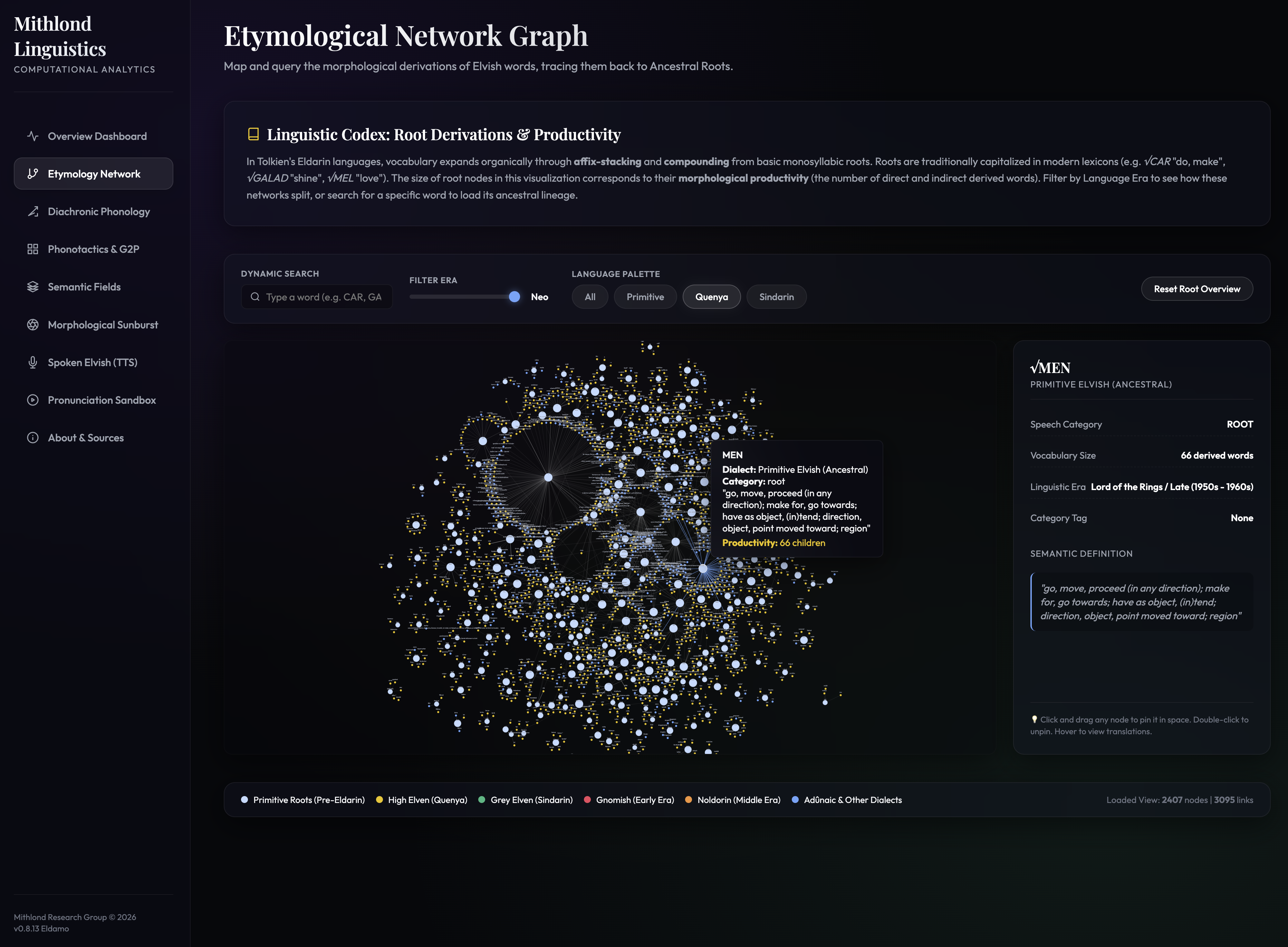
- Etymology Network: Visualizes ancestral word derivations and linguistic development pathways as an interactive node-link graph (pictured above).
- Diachronic Phonology: Tracks sound shifts step-by-step from Primitive Elvish roots to modern dialects.
- Phonotactics & G2P: Analyzes syllable structures and tests grapheme-to-phoneme transcription rules.
- Semantic Fields: Explores conceptual relationships and semantic groupings across vocabulary.
- Morphological Sunburst: Maps inflectional categories and grammatical structures in a hierarchical visualization.
- Spoken Elvish (TTS): Synthesizes high-fidelity pronunciations from raw text inputs.
- Pronunciation Sandbox: Provides a low-level testing ground for stress patterns and phonological conversions.
2. Standalone & Offline: Mithlond on macOS and iOS
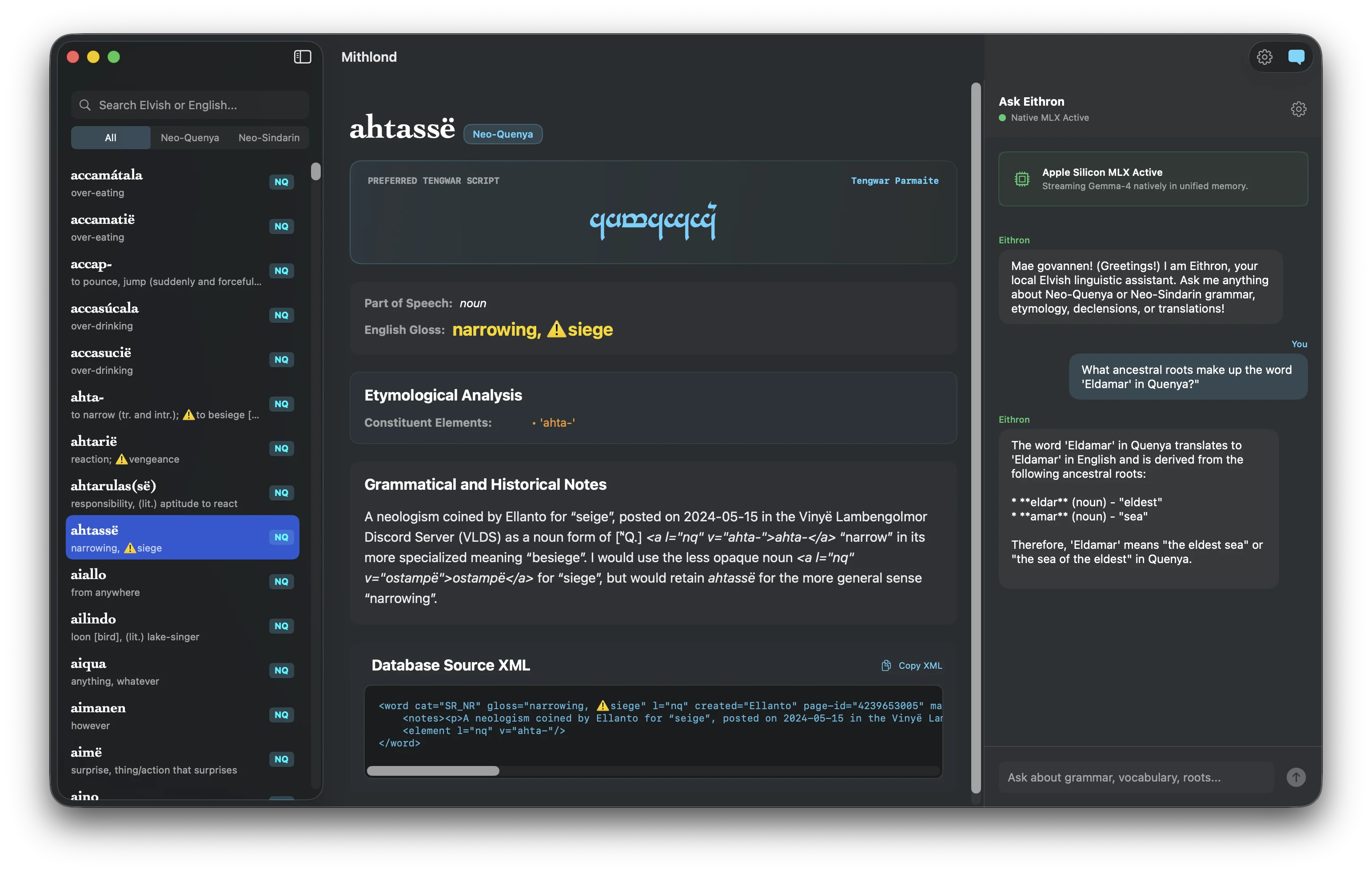
For users requiring access without internet connectivity, we have designed a standalone blueprint for Apple Silicon macOS and iOS platforms.
I'd also previously written a Gemma 4 tuning pipeline, mlxtune, which I used with Paul Strack's Eldamo lexicon to create EldamoGemma, a tuned model that can be used to interactively query the lexicon.
To keep a future App Store download under 20 megabytes, the application utilizes an on-demand resource background download system.
Key Architectural Pillars:
- Background Asset Downloader: On first launch, the app delegates the download of large assets (the 30-megabyte dictionary database and the 1.2-gigabyte quantized Elvish language model) to the operating system's background download daemon. This ensures the download completes even if the user locks their device. (For nerds, we have this in Google LiteRT-LM, Apple MLX, and GGUF formats.)
- Dynamic Font Registration: The app downloads custom Elvish Tengwar fonts and registers them directly into the CoreText rendering system at runtime. This maintains a light application package and removes the need for manual user installation.
- On-Device LLM Chat: Once assets are present, the app initializes a local, Metal-optimized model client (using Apple's MLX Swift framework). This powers a fully offline, private conversational assistant that answers linguistic and grammatical questions directly on your hardware.
3. The Future: Unified Semantic Search across Lore and Language
Linguistic databases and historical wikis have long operated in separate, isolated silos. To resolve this, I've drafted a short proposal to create a unified search system powered by multimodal embeddings, which will project text, images, and audio into a single vector space, so that we can map conceptual and structural relationships.
Sample Applications:
- Conceptual Vocabulary Search: Searching for "starry sky" returns phonetic matches like menel (sky) and silmë (silver light), even if those exact English search words do not exist in the raw dictionary entry.
- Cross-Database Tooltips: When a user reads a biography on a wiki, an interactive tooltip calculates etymological derivations, displaying the grammatical roots and playing a synthesized audio pronunciation.
- Visual-to-Linguistic Retrieval: Uploading an illustration of a coat of arms or a hand-drawn map matches the visual structures against the database to return the historical context and Elvish place-names associated with the artwork.
4: The Future: towards an ElvishGemma
Gemma 4 models get better and faster and smaller. The recently released Gemma 4 QAT means we could possibly have even smaller, off-line, mobile ready models tuned on open data.
Please see the Mithlond Project for more info.
Credits & Acknowledgements
The Mithlond project is made possible by the meticulous work of the Tolkien linguistic and open-source software communities. We credit and thank:
- Paul Strack (Eldamo): For compiling the definitive, ancestral Elvish lexicon database that serves as the foundation of our linguistic parsing.
- James Tauber (Digital Tolkien Project): For his computerized Tolkien text concordances and his open-source
ardalibrary, which provides our primary syllabification and stress-calculation logic. - The Tolkien Gateway Wiki: For managing the comprehensive, community-run encyclopedia of Middle-earth history, maps, and illustrations.
- hexgrad (Kokoro): For developing the open-source Kokoro-82M text-to-speech model and weight definitions that power our neural acoustic synthesis.