The linguistics analysis for the Mithlond Project has been updated with a few more visualizations of grammatical evolution.
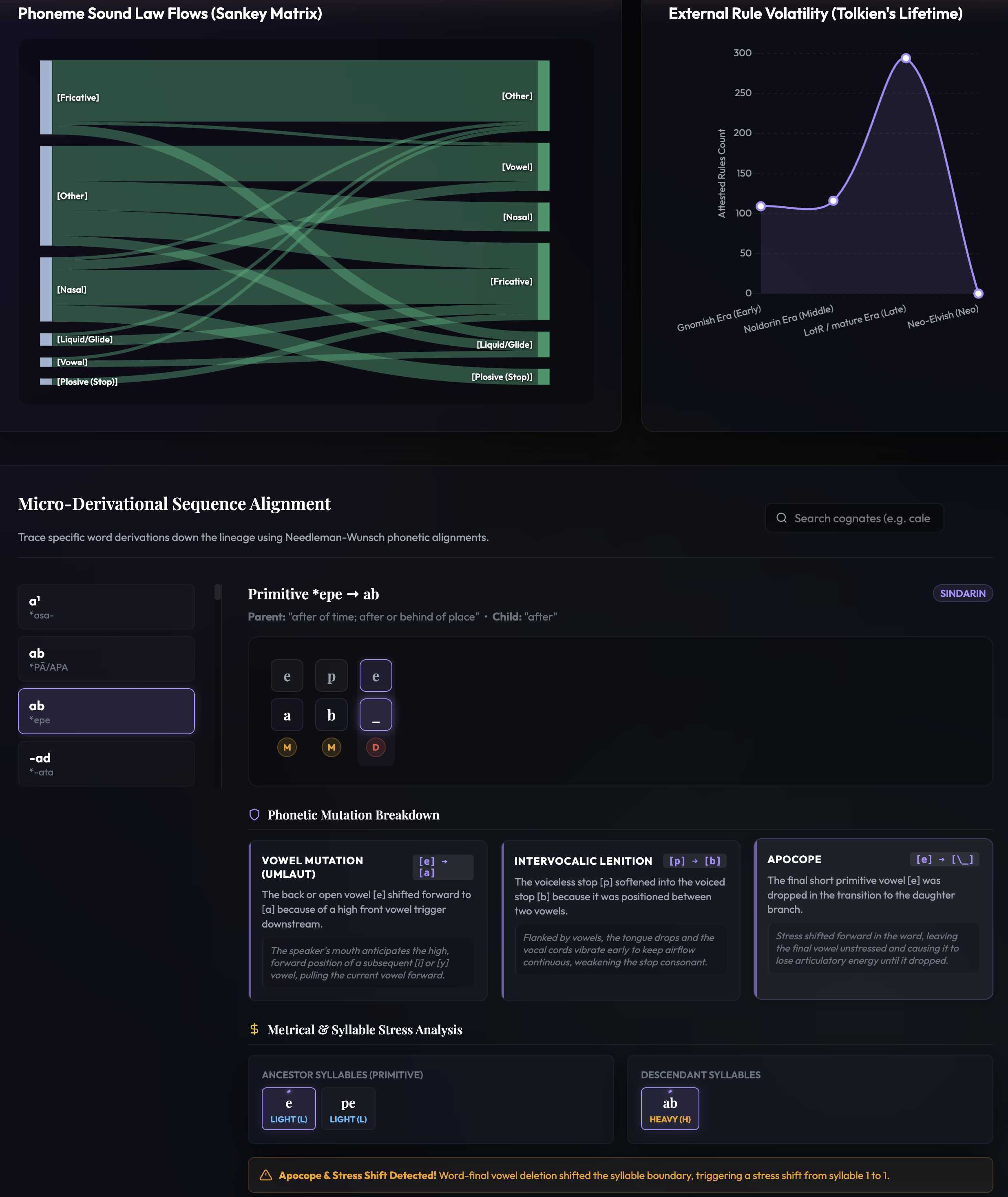
Following Carl F. Hostetter's critiques in "Elvish as She Is Spoke", the platform now models Tolkien's languages as historical grammars with evolving structural sound laws, rather than as static word-substitution ciphers.
1. Phonotactic & Metrical Engine
The backend data extraction pipeline now includes a phonology parser that automates historical grammar analysis:
- Syllabification Parser: Segments words into syllables, accounting for Elvish diphthongs (
ai,ei,oi,ui,au,eu,iu) and long/circumflex vowel markers. - Metrical Weight Calculator: Computes the weight of each syllable—categorizing them as Light (L) or Heavy (H) based on vowel length and coda consonants (closed syllables).
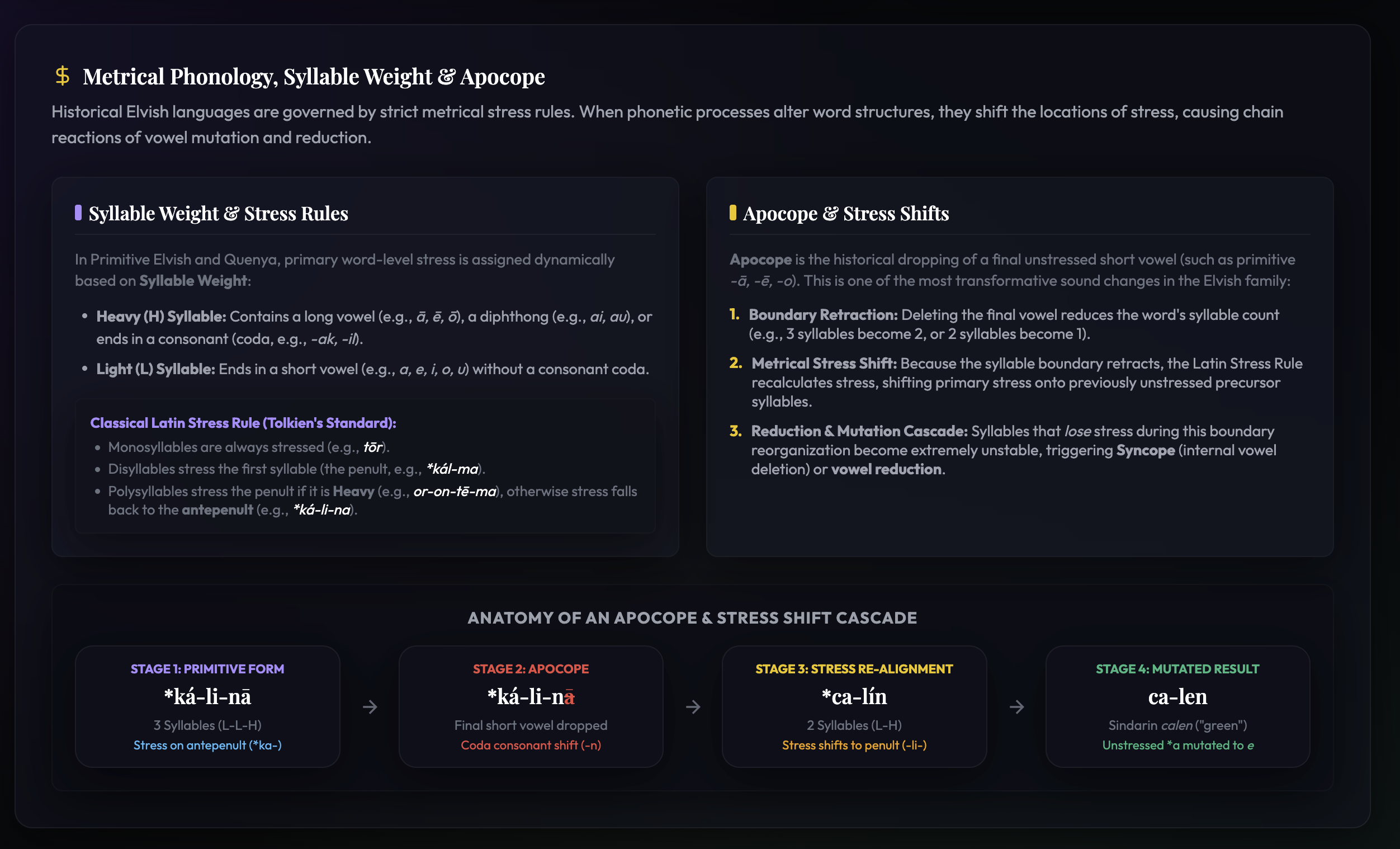
- Classical Stress Rules: Programmatically implements Tolkien's Latin-style stress rules. In words of three or more syllables, it evaluates the penult weight:
- If Heavy (H), stress is placed on the penult.
- If Light (L), stress pulls back to the antepenult.
- Apocope & Stress-Shift Mutators: Identifies historical Apocope (loss of final vowels), maps resulting stress shifts, and flags unstressed syllables at risk of vowel reduction or mutation.
- Phonological Accuracy: The syllabification rules identify diphthongs and syllable codas to calculate weight, matching the phonetic specifications in Tolkien's appendices.
- Stress Rule Fidelity: The implementation of the classical stress rule in
determine_stressmodels the weight-sensitive accentuation system of Quenya and Sindarin. - Historical Continuity: By modeling Apocope, stress-shifts, and unstressed vowel reduction, the system treats Elvish as a dynamic, historical language family rather than a static 1:1 translation code. This provides a clean dataset for training downstream translation and grammar models.
2. Frontend Interface
The web portal has been updated to visualize these phonological rules:
- Interactive Phonetic Mutation Panel: Displays sequence alignments mapping phonetic insertions, mutations, and deletions from Primitive Eldarin to Quenya or Sindarin.
- Metrical Stress Analysis Panel: A new interface component on the Phonology page showing syllable boundaries, weights, and the calculated stress position.
- Apocope Risk Warnings: Renders inline alerts indicating when unstressed syllables are prone to historical sound laws or vowel erosion.
- Linguistic Primer: A structured reference page explaining phonetic mutations, stress weights, and historical sound laws.